
- Tel: +86 813 2105845
- Fax: +86 813 2105845
- Mob: +86 13778532392
- Contact: Mr. Jacky
 info@dinosaurs-world.com
- Jackydinosworld@gmail.com
 Jackyyiming@gmail.com
 Jackyzengdinosaursworld
- Special Serrations Gave Carnivorous Dinosaurs an Evolutionary Edge
- Railroad spikes. Knives. Razors. The teeth of carnivorous dinosaurs like Allosaurus and Tyrannosaurus have been compared to plenty of piercing and cutting tools over the years, but such comparisons are far too rough. In a study published earlier this month, University of Toronto paleontologist Kirstin Brink and colleagues uncovered new evidence that the teeth of flesh-ripping dinosaurs possessed specialized internal structures that strengthened their impressive chompers.
Look closely at the tooth of a Gorgosaurus, Carcharodontosaurus, or most any carnivorous theropod dinosaur and you’ll see bumps of enamel on the front and back edges. Run your thumb along them – if you’re allowed to do so – and you can feel the subtle tickle of those little edges. You can feel why the steak knife comparison is so popular. But to really understand what makes theropod teeth special, you have to look inside the teeth as Brink and her coauthors did.
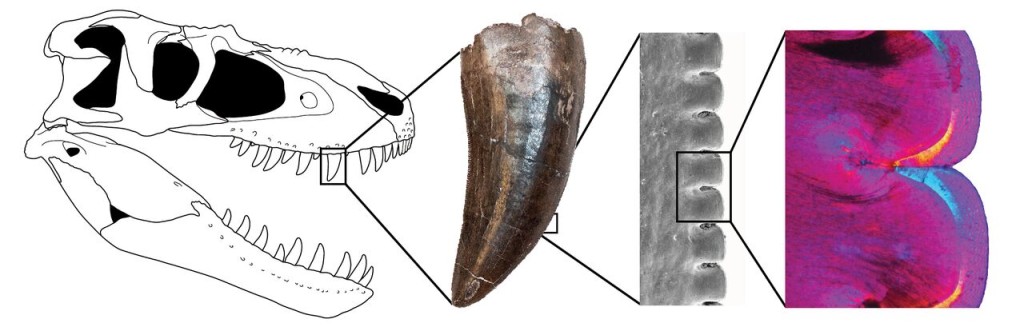
The teeth of carnivorous dinosaurs like Gorgosaurus were covered with small, strong serrations. Image courtesy Kirstin Brink.
Up close, seen in thin sections under powerful microscopes, each bump on the serrated edge meets with its neighbor in a deep fold. Paleontologist William Abler interpreted some of these as cracks that developed as the dinosaurs fed, creating tiny shock absorbers that took some of the force as the carnivores drove their teeth into flesh and bone. But Brink and colleagues have arrived at a different conclusion. The deep folds aren’t from damage. They’re a secret of theropod success.
In addition to a few non-dinosaurs used as independent checks, Brink and coauthors examined the teeth of various theropods ranging from the early, small Coelophysis to Cretaceous giants such as Tyrannosaurus and Carcharodontosaurus. All of them showed the tiny folds on both cutting edges, regardless of whether the animals in question had weak or powerful bites. What’s more, the team found that unerupted teeth – those that hadn’t yet come up over the gum line – had the same structures. The folds weren’t cracks created through impact. They had grown that way.
Deep folds like these haven’t been seen in any other carnivore. They were unique to theropods, and probably contributed to the success of these dinosaurs throughout the Mesozoic. The folds increased the depth of each bump – technically called a “denticle” – and strengthened it, making sure the tooth stayed in play longer. This became especially important as theropods attained giant size. Even though dinosaurs replaced teeth throughout their lives, Brink and colleagues point out, the rate at which theropods did so slowed down as they became bigger and bigger. Something as subtle as the microstructure of their teeth kept their dental armaments sharp for as long as possible, opening evolutionary avenues for some theropods to become the largest carnivores to ever stalk the Earth. 

 2015-09-07
 New dinosaur species help scientists fill in evolutionary gaps
- Feathered everything: just how many dinosaurs had feathers?
- Dinosaur Fossil With Fleshy Rooster's Comb Is First of Its Kind
- Scientists finally decode how dinosaurs turned into birds and learned how to fly
- Dark matter may have killed the dinosaurs, claims scientist
- New duck-billed dinosaur uncovered in Alaska, researchers say

- Contact Us
- Tel: +86 813 2105845
- Fax: +86 813 2105845
- Contact: Mr. Jacky
- info@dinosaurs-world.com
- Jackydinosworld@gmail.com
- Jackyyiming@gmail.com
- Jackyzengdinosaursworld
- Copyright @ 2009 - 2020 Zigong Dinosaurs World Science & Technology Co.,Ltd.